Whether you’re looking for a special present for someone close to you or you want to treat yourself to a new piece of jewellery, you’ve probably considered a precious gemstone. There are so many gemstones available; how do you choose which type to purchase?
Trying to decide what gem you want to choose for an engagement ring? Or perhaps you’re looking for a new gemstone to add to your own jewellery collection? No matter what you’re looking for, learn more about gemstones & minerals with Diamonds Factory.
What is a gemstone?

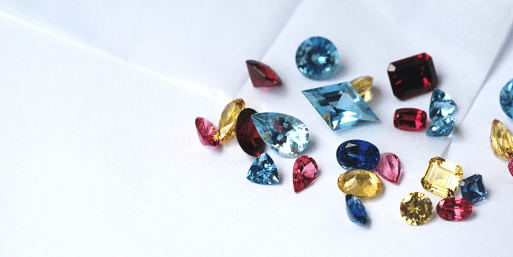
A gemstone is a precious stone that has been cut and polished. Usually, gemstones in jewellery are mineral crystals such as diamonds, rubies, or quartz. But sometimes, they are organic in nature, such as pearls, or are rocks, such as opal or obsidian. When they are cut and polished, they can be considered gemstones when they’re used in jewellery. Precious gemstones, like diamonds, rubies, and emeralds, are highly valued because of their rarity and usually sit between 8 and 10 on the Mohs scale of hardness.
Types of gemstones
Gemstones are usually classified as either precious or semi-precious. Precious gemstones are highly valuable and known for their rarity, beauty, and durability. These precious gemstones are:
Diamond
Diamonds are the most well-known and highly prized precious gemstones. The most coveted diamonds are called “white” but are almost completely colourless. Diamonds are known for their brilliance and hardness – they are the hardest mineral on Earth. These beautiful stones are favoured for engagement rings and are used in lots of other fine jewellery too.
Rubies are bright red gemstones that are highly valued for their vibrant colour and rarity. Chemically, they are exactly the same as sapphires (conundrum), but where sapphires can be found in a whole rainbow of shades, rubies are only red. The finest rubies are a deep red colour and are often more valuable than diamonds.
Sapphires are mostly commonly blue gemstones but can also be found in other colours, such as pink, yellow, and green. They are loved for their beauty and durability and are commonly used in engagement rings as they are believed to represent intelligence, wisdom, and fertility.
Green and vibrant emeralds are beautiful gemstones that are very rare and highly valued for their rich hue. The finest emeralds are a deep green colour and used to be coveted by royalty and nobility in ancient cultures. They’re often associated with wealth and prosperity and were worn for good luck.
Some of the most popular semi-precious gemstones are:
Once upon a time, garnets were believed to be the same as rubies, thanks to their vibrant red colour. They were loved by the Ancient Egyptians, Romans, and Greeks alike for their bright colour. They symbolise passion and sensuality.
Amethysts are a type of purple-coloured quartz that have been associated with having healing powers for centuries. In fact, the word “amethystos” actually means “not drunk” in ancient Greek and the stones were believed to fight off hangovers.
Because of its beautiful blue hue and its ties to siren and mermaid mythology, aquamarine has a strong association with water. Sailors would take aquamarine with them on long journeys as it was believed to protect them while at sea. Nowadays, aquamarine is thought to provide courage, help with mental clarity, and promote good health.
Peridot is a vibrant yellow-green gemstone and is the birthstone of August babies. It’s thought to help chase away bad dreams and is often used to give the wearer protection. Peridot is also considered a joyful, warm, and friendly stone, and it’s thought that it can ease anger or jealousy as well.
Blue topaz is a bright, clear stone that is thought to promote peace and healing. The Romans believed it could protect the wearer, whereas the ancient Egyptians thought that it contained the powers of Ra, the sun god. Nowadays, it symbolises love and fidelity and is said to bestow strength and intelligence to the wearer.
Tanzanite is a rare stone that is only found in one place on Earth – Tanzania. It’s thought that this violet stone has detoxifying effects and can help to improve physical energy as well as give the wearer good intuition thanks to its connection to the third eye.
Pearls are one of those gemstones that aren’t minerals. These organic gems are formed in the shells of molluscs and are very rare to find naturally (hence why they’re so coveted). Pearls have been sought after for centuries and used in jewellery and adornments and are often quite pricey but are well worth the investment.
Golden-hued citrine is the gemstone of luck and happiness. The sunshiney shade of these gemstones is often associated with good health and energy and is even thought to reverse bad luck, bringing good luck in its place.
Tourmaline is another gemstone that can be found in a whole rainbow of different shades. Pink tourmaline is the stone of love, compassion, and self-love, so makes for a beautifully unique piece of jewellery. It is considered a grounding and protective gemstone, thought to heal broken hearts and reconcile relationships.
How is a gemstone formed?

There are a few different ways that gemstones can be formed – hydrothermal, sedimentary, and metamorphism. Gemstones form deep in the Earth’s crust, with the lower surface containing numerous cavities due to heavy fractures. Water escapes through the cavities and fractures. Combined with high heat and high pressure, these cavities are the perfect places for crystals to form.
Hydrothermal gemstones are created when water that is super saturated with minerals is pushed up into cavities and cracks in the earth. As this mineral-rich solution begins to cool, the different minerals form crystals.
Sedimentary gemstones are created when mineral-rich water seeps down between cracks and cavities in the earth and deposits layers of minerals which harden and become gemstones.
But the majority of gemstones are formed by metamorphism. This is when minerals are forced together under great pressure and heat where they transform into different minerals, creating some of our most prized gemstones.
Can all minerals be gemstones?
While gemstones can be made up of many different types of minerals, not all minerals can be gemstones. Some minerals are not suitable for making gemstones while some are too soft or fragile. Others might even be toxic or just aren’t considered attractive enough (and therefore not valuable enough)
For example, Mozanite might be beautiful, but because it contains thorium and uranium, it’s radioactive and is not considered a gemstone.
Similarly, there are semi-precious stones that aren’t minerals but are considered gemstones. For example, amber (fossilised tree resin) is not a mineral but is durable enough, rare enough, and beautiful enough to be considered a gemstone. .
How to identify gemstones
Gemstones have some unique properties and characteristics that contribute to making them desirable and valuable. When identifying a gemstone, here are some of the most important factors that jewellers look out for when identifying gemstones:
Colour: Gemstones come in a wide range of colours, from deep red to pale pink to bright yellow and every shade in between. The colour of a gemstone will usually be influenced by factors like trace elements, impurities in the stone or the crystal structure of the gemstone.
Clarity: When talking about the clarity of a gemstone, we refer to how many inclusions or flaws it is. The clearest stones with the least amount of flaws usually have the highest price point.
Cut: The cut of a gemstone refers to the way it has been shaped to enhance its beauty and brilliance. A well-cut gemstone will have ideal proportions and good symmetry, allowing it to reflect light in the best way. A well cut stone may be smaller in carat weight than another stone but can appear larger – getting you better quality for your money.
Carat weight: The carat refers to its size and weight. One carat is equal to 200 milligrams.
Hardness: The hardness of a gemstone refers to its ability to resist scratching and abrasion. The Mohs scale is used to measure the hardness of minerals, with diamonds being the hardest at a 10 and talc being the softest at a 1. Most valuable precious and semi-precious fall between 8 and 10 on the hardness scale.
Lustre: The lustre of a gemstone refers to its ability to reflect light. A gemstone with a high lustre will be bright and shiny, while one with a low lustre will appear dull.
Refractive index: The refractive index refers to how much it bends light that passes through the gemstone. This property can greatly impact the gemstone’s brilliance and fire (the internal sparkle that is loved so much).
Fluorescence: Some gemstones fluoresce when exposed to UV light adding a unique feature to certain gemstones.
These properties and characteristics help jewellers and gemologists define the unique beauty and value of each gemstone. When combined with the rarity, availability, these factors can have a big impact on the value and desirability of a gemstone.
Is a gemstone a diamond?
All diamonds are gemstones but not all gemstones are diamonds. Whether you’re looking for a vintage-style emerald, a unique ruby, or a pink tourmaline for your loved one, look no further than Diamonds Factory’s range of gemstone jewellery.











 Unlock private sale access
 Birthday privileges
 Plus a world of exclusives, curated for you.


Whether you’re looking for a special present for someone close to you or you want to treat yourself to a new piece of jewellery, you’ve probably considered a precious gemstone. There are so many gemstones available; how do you choose which type to purchase?
4 Prong Setting Gemstone Bangle
3,363€
4 Prong Setting Gemstone Designer Stud Earrings
2,140€
4 Prong Setting Gemstone Delicate Bracelet
1,296€
4 Prong Setting Ruby Halo Pendant
418€
4 Prong Emerald Shaped Blue Sapphire Engagement Ring
959€
4 Prong Emerald Shaped Emerald Engagement Ring
911€
4 Prong Emerald Shaped Ruby Engagement Ring
945€
4 Prong Emerald Solitaire Pendant
385€
4 Prong Setting Halo Blue Sapphire Earring
1,146€
2 Prong Setting Round Blue Sapphire Tennis Bracelet
2,491€
3 Prong Setting Pear Ruby Halo Earring
261€
3 Prong Setting Pear Halo Blue Sapphire Pendant
206€
2 Prong Setting Emerald Drop Earrings
1,373€
2 Prong Setting Round Blue Sapphire Drop Earrings
1,364€
4 Prong Setting Oval Amethyst Three Stone Ring
1,186€
4 Prong Setting Oval Blue Topaz Three Stone Ring
1,186€
4 Prong Setting Oval Aquamarine Pendent
513€
4 Prong Setting Oval Aquamarine Tennis Bracelet
6,001€
4 Prong Setting Pear Blue Topaz Tennis Bracelet
5,798€
Trying to decide what gem you want to choose for an engagement ring? Or perhaps you’re looking for a new gemstone to add to your own jewellery collection? No matter what you’re looking for, learn more about gemstones & minerals with Diamonds Factory.
What is a gemstone?
A gemstone is a precious stone that has been cut and polished. Usually, gemstones in jewellery are mineral crystals such as diamonds, rubies, or quartz. But sometimes, they are organic in nature, such as pearls, or are rocks, such as opal or obsidian. When they are cut and polished, they can be considered gemstones when they’re used in jewellery. Precious gemstones, like diamonds, rubies, and emeralds, are highly valued because of their rarity and usually sit between 8 and 10 on the Mohs scale of hardness.
Types of gemstones
Gemstones are usually classified as either precious or semi-precious. Precious gemstones are highly valuable and known for their rarity, beauty, and durability. These precious gemstones are:
Diamond
Diamonds are the most well-known and highly prized precious gemstones. The most coveted diamonds are called “white” but are almost completely colourless. Diamonds are known for their brilliance and hardness – they are the hardest mineral on Earth. These beautiful stones are favoured for engagement rings and are used in lots of other fine jewellery too.
Ruby
Rubies are bright red gemstones that are highly valued for their vibrant colour and rarity. Chemically, they are exactly the same as sapphires (conundrum), but where sapphires can be found in a whole rainbow of shades, rubies are only red. The finest rubies are a deep red colour and are often more valuable than diamonds.
Sapphire
Sapphires are mostly commonly blue gemstones but can also be found in other colours, such as pink, yellow, and green. They are loved for their beauty and durability and are commonly used in engagement rings as they are believed to represent intelligence, wisdom, and fertility.
Emerald
Green and vibrant emeralds are beautiful gemstones that are very rare and highly valued for their rich hue. The finest emeralds are a deep green colour and used to be coveted by royalty and nobility in ancient cultures. They’re often associated with wealth and prosperity and were worn for good luck. Some of the most popular semi-precious gemstones are:
Garnet
Once upon a time, garnets were believed to be the same as rubies, thanks to their vibrant red colour. They were loved by the Ancient Egyptians, Romans, and Greeks alike for their bright colour. They symbolise passion and sensuality.
Amethyst
Amethysts are a type of purple-coloured quartz that have been associated with having healing powers for centuries. In fact, the word “amethystos” actually means “not drunk” in ancient Greek and the stones were believed to fight off hangovers.
Aquamarine
Because of its beautiful blue hue and its ties to siren and mermaid mythology, aquamarine has a strong association with water. Sailors would take aquamarine with them on long journeys as it was believed to protect them while at sea. Nowadays, aquamarine is thought to provide courage, help with mental clarity, and promote good health.
Peridot
Peridot is a vibrant yellow-green gemstone and is the birthstone of August babies. It’s thought to help chase away bad dreams and is often used to give the wearer protection. Peridot is also considered a joyful, warm, and friendly stone, and it’s thought that it can ease anger or jealousy as well.
Topaz
Blue topaz is a bright, clear stone that is thought to promote peace and healing. The Romans believed it could protect the wearer, whereas the ancient Egyptians thought that it contained the powers of Ra, the sun god. Nowadays, it symbolises love and fidelity and is said to bestow strength and intelligence to the wearer.
Tanzanite
Tanzanite is a rare stone that is only found in one place on Earth – Tanzania. It’s thought that this violet stone has detoxifying effects and can help to improve physical energy as well as give the wearer good intuition thanks to its connection to the third eye.
Pearl
Pearls are one of those gemstones that aren’t minerals. These organic gems are formed in the shells of molluscs and are very rare to find naturally (hence why they’re so coveted). Pearls have been sought after for centuries and used in jewellery and adornments and are often quite pricey but are well worth the investment.
Citrine
Golden-hued citrine is the gemstone of luck and happiness. The sunshiney shade of these gemstones is often associated with good health and energy and is even thought to reverse bad luck, bringing good luck in its place.
Tourmaline
Tourmaline is another gemstone that can be found in a whole rainbow of different shades. Pink tourmaline is the stone of love, compassion, and self-love, so makes for a beautifully unique piece of jewellery. It is considered a grounding and protective gemstone, thought to heal broken hearts and reconcile relationships.
How is a gemstone formed?
There are a few different ways that gemstones can be formed – hydrothermal, sedimentary, and metamorphism. Gemstones form deep in the Earth’s crust, with the lower surface containing numerous cavities due to heavy fractures. Water escapes through the cavities and fractures. Combined with high heat and high pressure, these cavities are the perfect places for crystals to form.
Hydrothermal gemstones are created when water that is super saturated with minerals is pushed up into cavities and cracks in the earth. As this mineral-rich solution begins to cool, the different minerals form crystals.
Sedimentary gemstones are created when mineral-rich water seeps down between cracks and cavities in the earth and deposits layers of minerals which harden and become gemstones.
But the majority of gemstones are formed by metamorphism. This is when minerals are forced together under great pressure and heat where they transform into different minerals, creating some of our most prized gemstones.
Can all minerals be gemstones?
While gemstones can be made up of many different types of minerals, not all minerals can be gemstones. Some minerals are not suitable for making gemstones while some are too soft or fragile. Others might even be toxic or just aren’t considered attractive enough (and therefore not valuable enough)
For example, Mozanite might be beautiful, but because it contains thorium and uranium, it’s radioactive and is not considered a gemstone.
Similarly, there are semi-precious stones that aren’t minerals but are considered gemstones. For example, amber (fossilised tree resin) is not a mineral but is durable enough, rare enough, and beautiful enough to be considered a gemstone. .
How to identify gemstones
Gemstones have some unique properties and characteristics that contribute to making them desirable and valuable. When identifying a gemstone, here are some of the most important factors that jewellers look out for when identifying gemstones:
Colour: Gemstones come in a wide range of colours, from deep red to pale pink to bright yellow and every shade in between. The colour of a gemstone will usually be influenced by factors like trace elements, impurities in the stone or the crystal structure of the gemstone.
Clarity: When talking about the clarity of a gemstone, we refer to how many inclusions or flaws it is. The clearest stones with the least amount of flaws usually have the highest price point.
Cut: The cut of a gemstone refers to the way it has been shaped to enhance its beauty and brilliance. A well-cut gemstone will have ideal proportions and good symmetry, allowing it to reflect light in the best way. A well cut stone may be smaller in carat weight than another stone but can appear larger – getting you better quality for your money.
Carat weight: The carat refers to its size and weight. One carat is equal to 200 milligrams.
Hardness: The hardness of a gemstone refers to its ability to resist scratching and abrasion. The Mohs scale is used to measure the hardness of minerals, with diamonds being the hardest at a 10 and talc being the softest at a 1. Most valuable precious and semi-precious fall between 8 and 10 on the hardness scale.
Lustre: The lustre of a gemstone refers to its ability to reflect light. A gemstone with a high lustre will be bright and shiny, while one with a low lustre will appear dull.
Refractive index: The refractive index refers to how much it bends light that passes through the gemstone. This property can greatly impact the gemstone’s brilliance and fire (the internal sparkle that is loved so much).
Fluorescence: Some gemstones fluoresce when exposed to UV light adding a unique feature to certain gemstones.
These properties and characteristics help jewellers and gemologists define the unique beauty and value of each gemstone. When combined with the rarity, availability, these factors can have a big impact on the value and desirability of a gemstone.
Is a gemstone a diamond?
All diamonds are gemstones but not all gemstones are diamonds. Whether you’re looking for a vintage-style emerald, a unique ruby, or a pink tourmaline for your loved one, look no further than Diamonds Factory’s range of gemstone jewellery.